

Why Is My Air Right Angle Screwdriver Losing Power Even With Full Air Pressure
2026-06-17
If you rely on pneumatic tools daily, few things are more frustrating than pulling the trigger on your Air Right Angle Screwdriver only to feel sluggish rotation and weak torque—despite your compressor gauge showing a steady 90 PSI. You check the hose, verify the regulator, and everything reads normal. Yet the tool underperforms. This paradox is more common than you think, and at WYMA, we have diagnosed thousands of such cases across automotive, aerospace, and assembly lines. The root cause is almost never "low air" in the traditional sense. Let us walk you through the real culprits.
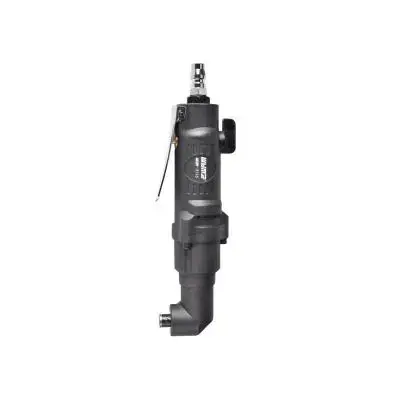
The Illusion of "Full Pressure"
Your compressor gauge measures static pressure—air sitting in the tank. But your Air Right Angle Screwdriver requires dynamic flow (CFM) at operating speed. A blocked filter, a kinked hose, or undersized fittings can drop delivered pressure by 15–20 PSI the moment you trigger the tool. This is the #1 overlooked issue. Use a plug-in pressure gauge at the tool inlet while running. If it reads below 85 PSI under load, your supply system is the bottleneck.
6 Common Causes of Power Loss (and How to Fix Them)
| Cause | Symptoms | Solution |
|---|---|---|
| Clogged inlet screen/filter | Gradual power decline over weeks | Clean or replace the screen monthly |
| Worn rotor vanes | Sudden drop, especially hot | Replace vane kit (every 500–800 operating hours) |
| Leaking O-rings or seals | Hissing sound, oil residue | Rebuild with WYMA genuine seal kit |
| Incorrect lubricant viscosity | Sticky throttle response | Use ISO VG 32 pneumatic oil only |
| Exhaust muffler blockage | Back-pressure, overheating | Soak in solvent and blow dry |
| Coupler/plug mismatch | Intermittent power surging | Use high-flow (1/4" NPT) industrial couplers |
The Oil Factor That Most Technicians Ignore
Every Air Right Angle Screwdriver has a precision air motor that depends on a thin oil film for sealing and lubrication. Too little oil—vanes stick and lose compression. Too much oil—hydraulic lock reduces RPM. The correct rate is 2–3 drops per minute of continuous use, injected directly into the inlet port. WYMA tools feature a visible oil-fog window to help you monitor this. Also, never use WD-40 or motor oil; they swell seals and carbonize vanes.
Torque vs. RPM: Which One Are You Actually Losing?
Many operators mistake RPM loss for torque loss. If your Air Right Angle Screwdriver spins freely but stalls under load, the issue is torque drop—usually from worn clutch springs or a damaged cam follower. If it spins slowly even with no load, the problem is air volume or vane wear. Perform this simple test:
-
No-load RPM → Use a tachometer. If below 80% of rated spec, check vanes and air supply.
-
Stall torque → Use a torque transducer. If below 70% of rated spec, inspect clutch and gear train.
3 Essential FAQs About Your Air Right Angle Screwdriver
Q: Can a longer air hose cause power loss even if pressure at the compressor is correct?
A: Yes, significantly. Every 25 feet of 3/8" ID hose drops about 3–4 PSI at 10 CFM. If you use 50 feet of 1/4" ID hose, that drop exceeds 12 PSI under load. For consistent performance with any Air Right Angle Screwdriver, we recommend 3/8" ID hose for runs under 50 feet, and 1/2" ID for longer distances. Also, install a secondary regulator and filter at the tool end for critical applications.
Q: How often should I rebuild the motor on my Air Right Angle Screwdriver, and what signs indicate it is time?
A: Based on WYMA field data, light-duty users (intermittent use) can go 1,200–1,500 hours between rebuilds. Heavy production users (8+ hours daily) should schedule inspection at 600 hours. Warning signs include: (a) erratic RPM that surges and dips, (b) excessive air consumption without proportional output, (c) metal particles in the exhaust, and (d) audible scraping or knocking. A full rebuild includes new vanes, bearings, O-rings, and a cylinder honing. Always use WYMA factory-spec parts to maintain original clearances.
Q: Does ambient temperature affect the performance of my Air Right Angle Screwdriver, and how can I compensate?
A: Absolutely. Pneumatic motors are sensitive to air density. At 40°F, air is denser and carries more oxygen molecules per cubic foot, which actually increases power slightly—but moisture condensation becomes a risk. At 100°F+ (common in foundries or summer automotive shops), air expands and reduces mass flow, causing a 5–8% power drop. To compensate: (a) install an aftercooler on your compressor, (b) use a desiccant dryer to keep dew point below -20°F, and (c) increase your regulated pressure by 5 PSI in hot environments (but never exceed the tool's max rating of 100 PSI). WYMA tools are tested across -10°C to 50°C to ensure stable torque curves.
Proactive Maintenance Schedule (Recommended by WYMA)
| Interval | Action |
|---|---|
| Daily | Drain water from compressor tank; lubricate 2–3 drops before use |
| Weekly | Clean inlet filter; check coupler for wear |
| Monthly | Inspect exhaust muffler; test no-load RPM with tachometer |
| Quarterly | Replace vanes if RPM drops >10% from baseline |
| Annually | Full motor rebuild with WYMA certified kit |
When to Retire vs. Repair
If your Air Right Angle Screwdriver has undergone two full rebuilds and still cannot maintain 80% of original torque, the housing or cylinder bore may be ovalized. At that point, repair costs often exceed 60% of a new WYMA unit. Our replacement tools come with a 2-year performance warranty and a trade-in credit for old pneumatics.
Final Verdict
Power loss with full static pressure is almost always a flow, vane, or seal issue—not a compressor failure. Start with a dynamic pressure check at the tool inlet, then inspect your lubricant and air quality. Document your RPM baseline and compare weekly. With systematic diagnosis, 9 out of 10 cases are resolved for under $50 in parts. For the remaining 1%, WYMA offers same-day technical support and 48-hour parts shipping to keep your production moving.
Contact Us – If you have already tried these steps and your Air Right Angle Screwdriver still underperforms, our team of pneumatic specialists is ready to help. Reach out to WYMA through our website's live chat or call our technical hotline. We provide free diagnostic consultations, custom rebuild kits, and on-site training for your maintenance crew. Do not let a sluggish tool slow your bottom line—get in touch today, and we will have your threaded fasteners running at full torque within 24 hours.