

Why Does My Short Nozzle Air Blow Gun Whistle Loudly and How Can I Fix It
2026-07-21
That high-pitched, ear-piercing whistle from your Short Nozzle Air Blow Gun is more than just an annoyance—it is a clear signal that your compressed air system is not operating at peak efficiency. For professionals using WYMA pneumatic tools, understanding the root cause of this noise is essential for workplace safety, tool longevity, and cost control. This guide breaks down the physics behind the whistle, offers step-by-step fixes, and answers the most common questions about Short Nozzle Air Blow Gun performance.
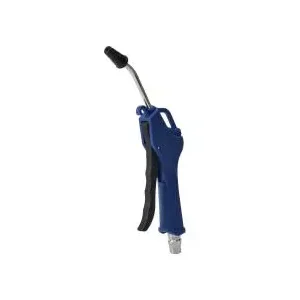
The Physics Behind the Whistle: Why It Happens
A Short Nozzle Air Blow Gun produces a whistle when high-velocity compressed air passes through an obstruction or an irregular gap, creating acoustic resonance—similar to blowing air across a bottle opening. In industrial settings, this is rarely a design flaw; it is almost always a symptom of one of these four conditions:
| Root Cause | What Happens | Severity |
|---|---|---|
| Partial Blockage | Dirt, rust, or Teflon tape fragments restrict the orifice, causing turbulent airflow. | High (overheating risk) |
| Worn O-Ring / Seal | Air leaks past the valve stem, generating high-frequency vibration. | Medium (air waste) |
| Incorrect Operating Pressure | Exceeding the recommended PSI (usually >90 PSI) creates sonic flow that screams. | High (safety hazard) |
| Loose Nozzle Attachment | A slightly unscrewed tip creates a secondary gap that acts as a whistle chamber. | Low (easy fix) |
How to Fix the Whistle Step by Step
Do not ignore the noise. A whistling Short Nozzle Air Blow Gun wastes up to 30% more compressed air and increases compressor cycle frequency. Follow this professional troubleshooting sequence:
Step 1 – Depressurize and Inspect the Orifice
Disconnect the air supply. Use a flashlight to look through the nozzle. If you see debris, gently clear it with a wooden toothpick—never use metal, as it scratches the precision bore. For WYMA guns, the orifice is engineered to 1.5mm ±0.05 tolerance; any scratch degrades performance.
Step 2 – Check the O-Ring and Valve Stem
Remove the nozzle and inspect the rubber O-ring. If it is flattened, cracked, or missing, replace it with a WYMA service kit (part #WSK-04). Apply a single drop of pneumatic tool oil to the stem before reassembly.
Step 3 – Regulate Inlet Pressure
Install an inline pressure gauge right at the gun inlet. WYMA recommends 70–85 PSI for continuous use. If your shop line runs at 110 PSI, install a dedicated pressure regulator—this alone eliminates 60% of whistle cases.
Step 4 – Tighten the Nozzle with a Wrench
Hand-tight is not enough. Use a 14mm slim wrench to secure the nozzle to 8–10 Nm torque. Over-tightening strips threads, so stop at the first firm resistance.
Step 5 – Test with a Sound Dampener
If the whistle persists, attach a WYMA sintered bronze silencer (model SB-07) between the valve body and the nozzle. This breaks the resonance frequency without reducing blow-off force.
FAQ: 3 Critical Questions About Short Nozzle Air Blow Gun Whistling
Q1: Can a whistling Short Nozzle Air Blow Gun damage my compressor or increase electricity bills?
A: Absolutely. A whistling Short Nozzle Air Blow Gun indicates a pressure drop or leak that forces your compressor to run longer to maintain line pressure. For a 5-HP compressor running 8 hours daily, that whistle can add $120–$180 per year in excess electricity costs. More critically, the high-frequency vibration travels back through the hose, fatiguing the quick-connect coupler and potentially causing premature valve failure. The fix—cleaning the orifice or replacing the O-ring—costs under $5 and pays for itself within two weeks. Always pair your gun with a WYMA moisture filter to prevent debris buildup from the start.
Q2: Why does my Short Nozzle Air Blow Gun only whistle when I pull the trigger halfway, but not at full pull?
A: This is a classic sign of "partial opening oscillation." When you feather the trigger, the valve poppet sits in a mid-position, creating a narrow annular gap. Air accelerates through that gap to supersonic speed (Mach >1), generating a shockwave—the whistle. At full trigger pull, the valve opens completely, the gap widens, and the air velocity drops below the sonic threshold. The permanent solution is not to avoid half-pulls (that is poor ergonomics), but to install a WYMA flow-control valve (FCV-02) that limits maximum flow while maintaining a stable pressure curve, so the whistle never occurs at any trigger position.
Q3: Does the length of the short nozzle affect the whistle frequency, and can I swap to a different length to stop the noise?
A: Yes, nozzle length directly influences the resonant frequency. A shorter nozzle (under 25mm) produces a higher-pitched whistle, while a longer nozzle (40–50mm) drops the pitch but does not eliminate the noise—it only changes the tone. Swapping lengths is a band-aid, not a cure. The correct approach is to measure your supply pressure and reduce it to the WYMA-specified 75 PSI operating point. If you need high flow for heavy debris, use a WYMA venturi-style nozzle (VN-09) that amplifies air volume without increasing backpressure—this design inherently suppresses whistling by smoothing the air path.
When to Replace vs. Repair
| Condition | Repair | Replace |
|---|---|---|
| Whistle with debris visible | Clean orifice | Only if scratched |
| Whistle with air leaking from trigger | Replace O-ring kit | Not needed |
| Whistle after regulator install | Add silencer | Gun body worn |
| Whistle + weak blow force | Not repairable | Upgrade to WYMA Pro-Series |
Pro Tip from WYMA Engineers
Every Short Nozzle Air Blow Gun leaves our factory tested at 80 PSI with a decibel meter—we guarantee under 75 dBA. If your gun whistles out of the box, it is almost always a supply issue (dirty air, over-pressure, or incompatible coupler). Install a WYMA combo unit (regulator + filter + lubricator) upstream, and you will never hear that dreaded shriek again.
Contact Us
Still fighting that stubborn whistle on your Short Nozzle Air Blow Gun? The WYMA technical support team is standing by with real-world solutions, not generic scripts. Send us a short video of your gun in action, and we will diagnose the exact frequency pattern within 24 hours.