

How Do You Maintain and Store a Hammer Punch Set for Maintenance Properly
2026-06-22
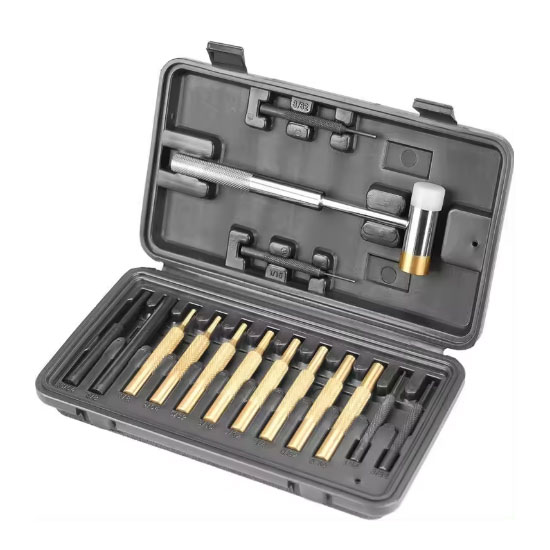
A Hammer Punch Set for Maintenance is one of the most relied-upon tools in any professional workshop, automotive garage, or industrial maintenance bay. It delivers precise impact marks, drives out stubborn pins, and aligns components before fastening. However, even the toughest punch set loses its effectiveness when neglected. Poor storage leads to rust, misaligned tips, and handle damage—all of which compromise safety and accuracy. This guide walks through the professional maintenance and storage protocols that extend the life of your set, with proven methods used by field technicians and toolroom managers. When you invest in a quality set from Hunting Speed, you also invest in the discipline of caring for it correctly.
Why Maintenance Matters More Than You Think
A punch that slips due to a mushroomed head or a pitted tip is not just inaccurate—it is dangerous. Routine maintenance ensures consistent strike transmission, reduces the risk of flying debris, and preserves the hardness of the steel. For maintenance professionals, a well-maintained Hammer Punch Set for Maintenance translates to fewer reworks, less material damage, and faster job completion. Hunting Speed recommends integrating these care steps into your end-of-day routine, not as an afterthought but as a standard operating procedure.
Daily Maintenance Checklist (Best Practice Schedule)
| Frequency | Action | Purpose |
|---|---|---|
| After each use | Wipe down with a lint-free cloth soaked in light machine oil | Removes moisture, metal shavings, and grime |
| Weekly | Inspect tips for rounding or chipping under 5× magnification | Catches micro-damage before it worsens |
| Monthly | Dress mushroomed heads with a fine bench grinder (coolant-fed) | Restores flat striking surface and prevents spalling |
| Quarterly | Calibrate storage inserts and check for rust in hidden grooves | Ensures storage system remains moisture-free |
Step-by-Step Professional Maintenance Procedure
-
Cleaning – Degrease each punch using a non-chlorinated solvent. Avoid soaking; use a brush for knurled handles. Dry thoroughly with compressed air.
-
Inspecting Striking Faces – Look for radial cracks or “mushroom” flares. Any flare exceeding 1/16 inch over the original diameter must be ground down. Hunting Speed advises using a dressing stick rather than a coarse wheel to preserve the temper.
-
Dressing the Tips – For pointed punches, restore the factory angle (typically 60° for general use). Use a honing guide and a fine diamond stone. For pin punches, square off the tip squarely to avoid walking.
-
Lubrication – Apply a thin layer of anti-seize or rust-inhibiting oil to all bare metal surfaces. Wipe off excess—too much attracts dust.
-
Function Test – Tap each punch lightly on a scrap piece of mild steel. A clear, crisp ring indicates proper hardness. A dull thud suggests softening (replace immediately).
Proper Storage: Environmental and Physical Controls
Storage is equally critical. Even a perfectly maintained Hammer Punch Set for Maintenance can degrade overnight if stored incorrectly.
| Storage Factor | Ideal Condition | Why It Matters |
|---|---|---|
| Humidity | Below 50% relative humidity | Prevents pitting and electrolytic corrosion |
| Temperature | 50–75°F (10–24°C) stable | Avoids condensation from thermal cycling |
| Separation | Individual molded slots or foam cutouts | Prevents tip-to-tip contact and edge dulling |
| Orientation | Vertical (tips down) or horizontal with supports | Protects striking ends from accidental drops |
| Material | High-density closed-cell foam (not cardboard) | Cardboard traps moisture; foam wicks it away |
Hunting Speed recommends a dedicated tool roll with anti-corrosion treated fabric for mobile maintenance crews, and a locking steel chest with desiccant packs for shop-based professionals. Never store punches loose in a drawer—this is the number one cause of premature failure.
3 Frequently Asked Questions About Hammer Punch Set for Maintenance
FAQ 1: How often should I dress the striking end of a punch in a Hammer Punch Set for Maintenance?
Answer: Dressing frequency depends on usage volume and strike force. For daily heavy-duty applications (e.g., automotive suspension work), inspect the striking end every 40–50 strikes. As a rule, dress the head whenever you see a visible lip or flare exceeding 0.5 mm beyond the shank diameter. Use a low-speed grinder with a cool-running wheel (aluminum oxide, 46-grit) and dip the punch in water every 2–3 seconds to avoid drawing the temper. After dressing, lightly chamfer the edge to prevent sharp burrs. If you dress the head more than three times in a single month, consider upgrading to a higher-alloy set from Hunting Speed—their proprietary heat treatment extends dressing intervals by up to 300%.
FAQ 2: Can I store my Hammer Punch Set for Maintenance in a magnetic tool holder without damaging it?
Answer: Yes, but with significant caveats. A magnetic strip does not harm the metallurgy or hardness of chrome-vanadium or S2 steel punches. However, magnetism can attract fine ferrous particles that embed into the tip surface, acting as an abrasive during subsequent strikes. This accelerates tip wear and mars workpiece finishes. If you prefer magnetic storage, Hunting Speed recommends wiping each punch with a demagnetizing wand weekly and placing a thin plastic sleeve over the magnetic bar to catch debris. For long-term storage (over one week), non-magnetic foam inserts are safer. Magnetic holders are best suited for active job-site use, not for permanent storage.
FAQ 3: What is the single most damaging storage mistake for a Hammer Punch Set for Maintenance?
Answer: Storing punches in a damp toolbox without any vapor-corrosion inhibitor (VCI) or desiccant. Moisture trapped between the punch and a foam liner initiates crevice corrosion within 48 hours. This is especially destructive because the pitting often occurs under the handle knurling, where it goes unnoticed until the punch fractures under impact. The second worst mistake is stacking punches horizontally on top of each other—this causes tip deformation and creates stress risers. Hunting Speed strongly advises using vertical stands with individual bores, or at minimum, wrapping each punch in VCI paper before placing it in a drawer. For mobile technicians, a PVC pipe rack with drilled drain holes is an excellent low-cost solution that allows air circulation while keeping punches separated.
Professional Recommendation Table by Application
| Application Type | Recommended Maintenance Interval | Preferred Storage Method | Best Hunting Speed Model |
|---|---|---|---|
| Automotive chassis work | Daily cleaning + weekly dressing | Foam insert in rolling cart | HS-834P (6-piece pin set) |
| Industrial assembly line | Shift-end wipe + monthly grind | Locked cabinet with silica gel | HS-912H (heavy-duty 9-pc) |
| Field service / mobile | After-job wipe + biweekly inspection | Anti-corrosion tool roll | HS-605M (compact 5-pc) |
| Precision machining | Each use + diamond stone touch-up | Individual wood blocks | HS-208P (precision-ground) |
Final Pro Tips from Hunting Speed
-
Always strike with a hammer that is softer than the punch material (e.g., brass or rawhide mallet) to preserve the striking face.
-
Rotate your punches in a first-in, first-out system so that no single punch sees disproportionate wear.
-
Mark each punch with a colored band (heat-shrink tubing) to quickly identify sizes without touching the tip.
-
Replace any punch that shows visible bending—straightening weakens the grain structure and invites catastrophic failure.
Contact Us
Proper maintenance and storage are just the beginning. If you want a Hammer Punch Set for Maintenance that is engineered to withstand real-world abuse while holding a precise edge, Hunting Speed delivers exactly that. Every set is forged, heat-treated, and finished in facilities that meet ISO 9001 standards—backed by a no-questions-asked warranty on manufacturing defects. Ready to upgrade your maintenance toolkit or need a custom storage solution? Contact us today for bulk pricing, technical datasheets, or personalized recommendations. Our team responds within 4 business hours and offers free shipping on qualifying orders. Reach out via the contact form on our website or call our support line—we are here to keep your punches punching, strike after strike.